
In January of 2026, Google introduced the universal commerce protocol (UCP). AI agents can now find products, compare them to each other, and make purchases from the AI without the shopper ever having to visit an e-commerce website. This move completely changes how e-commerce sites will use on-page seo.
To succeed today, you have to be successful at two things: one is getting your product ranked as high as possible in the search engines, and the second is making sure Google’s AI agent selects your product when it comes to completing a transaction.
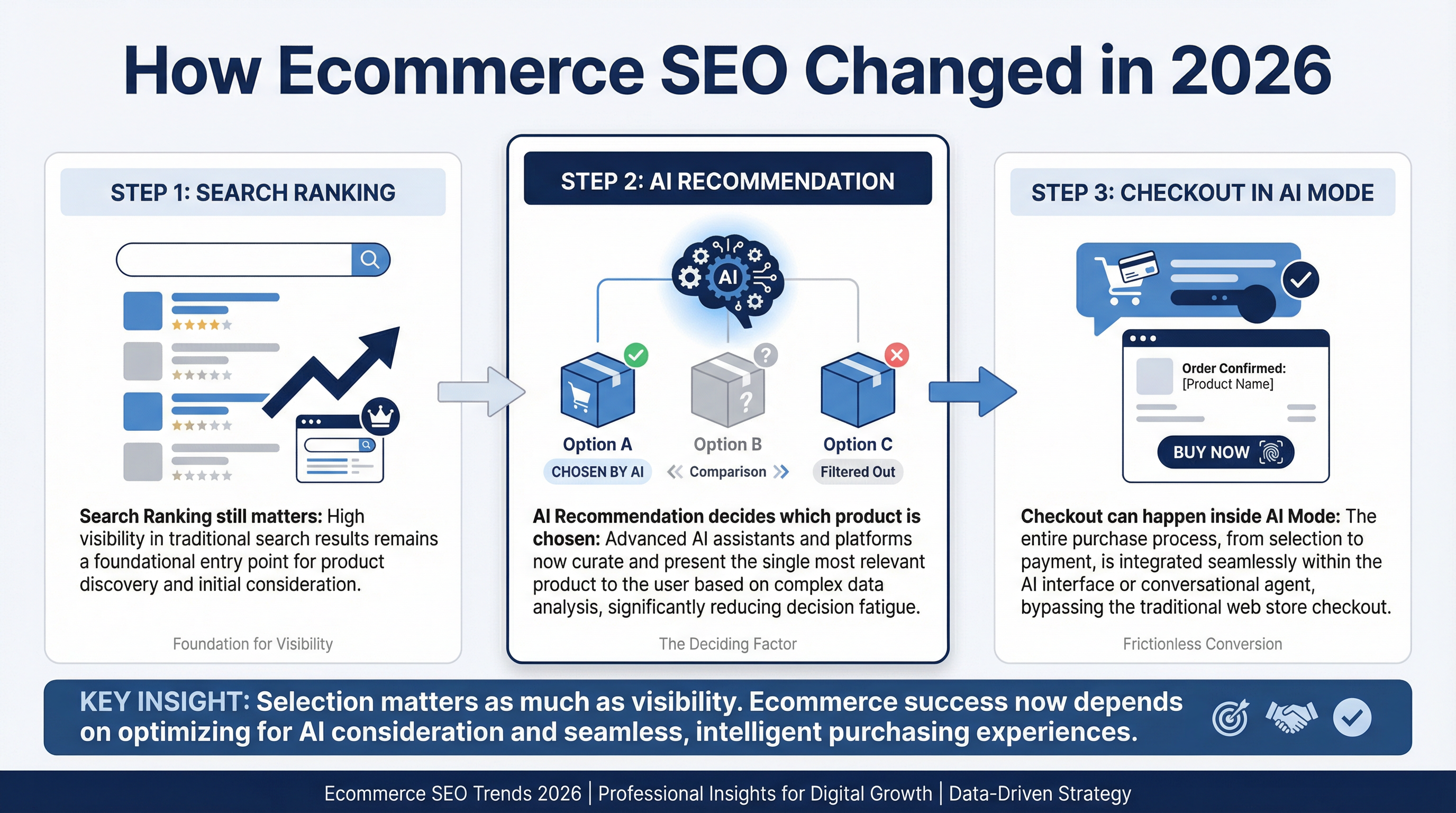
In 2026 ecommerce SEO has two jobs: rank your products in traditional search and make sure Google’s AI agent selects them when a purchase is about to happen.
What Changed: The New Ecommerce SEO Landscape (March 2026)
Business Agent
AI assistant inside Google Search and Gemini that answers shopper questions in real time.
Direct Offers
Brands can place promotional messaging directly into the AI recommendation process.
Checkout in AI Mode
Google AI completes the purchase in its own interface without sending the shopper to the website.
For many years, ecommerce seo was about creating a product page so it would rank for transactional keywords. If a product page appeared on the first page of search results, traffic followed.
That model is quickly disappearing.
Google’s AI commerce system consists of three different layers of operations; the first layer is Business Agent, an AI assistant that is embedded in Google Search and Gemini that answers shopper questions in real-time. The second layer is called Direct Offers, which allows brands to put their promotional messaging directly into the AI recommendation process. The third layer is called Check out in AI mode, where the Google AI completes the purchase within its own interface and doesn’t send the shopper to the e-commerce website.
All of this is made possible by the Universal Commerce Protocol (UCP), which is an open standard that was developed with some of the largest platforms, such as Shopify, Etsy, Wayfair, Target, and Walmart. The UCP enables AI systems to read product data in real-time and match those products directly to shopper needs.
AI Overviews currently display on roughly 47% of search queries, and the organic click-through rate (CTR) for informational content has decreased approximately 58%. The traffic pattern of almost every e-commerce website is changing.
No,w what is important is the Search Intent Depth. When a shopper types in a keyword phrase, it is no longer a simple keyword phrase like “waterproof jacket.” Instead, the shopper describes a situation.
I need a waterproof jacket for a spring trip to Scotland
The AI interprets the context of that statement and then looks up product data that fits the entire situation — weather, mobility, durability, and budget. If the product pages on your e-commerce site only focus on single keywords, they are missing most of the shopper’s intent.
The question that ecommerce teams should ask themselves is no longer “Do we rank?”
Instead, it is “Does Google’s AI select our product?”
Takeaway: In 2026 ecommerce SEO is about getting selected by the AI, not just about ranking.
Product Page Optimization for AI Selection
The product page is the single most valuable asset on an e-commerce website. The process of optimizing the product page has drastically changed.
Both search engines and AI systems still scan product pages, however; AI systems also utilize structured data extracted from product pages to create product recommendations.
A product page optimized today for both Search Engine Optimization (SEO) and Artificial Intelligence (AI) Recommendations needs to meet both traditional Search Engine Ranking Signals (SERS), and the newer AI Recommendation Layer.
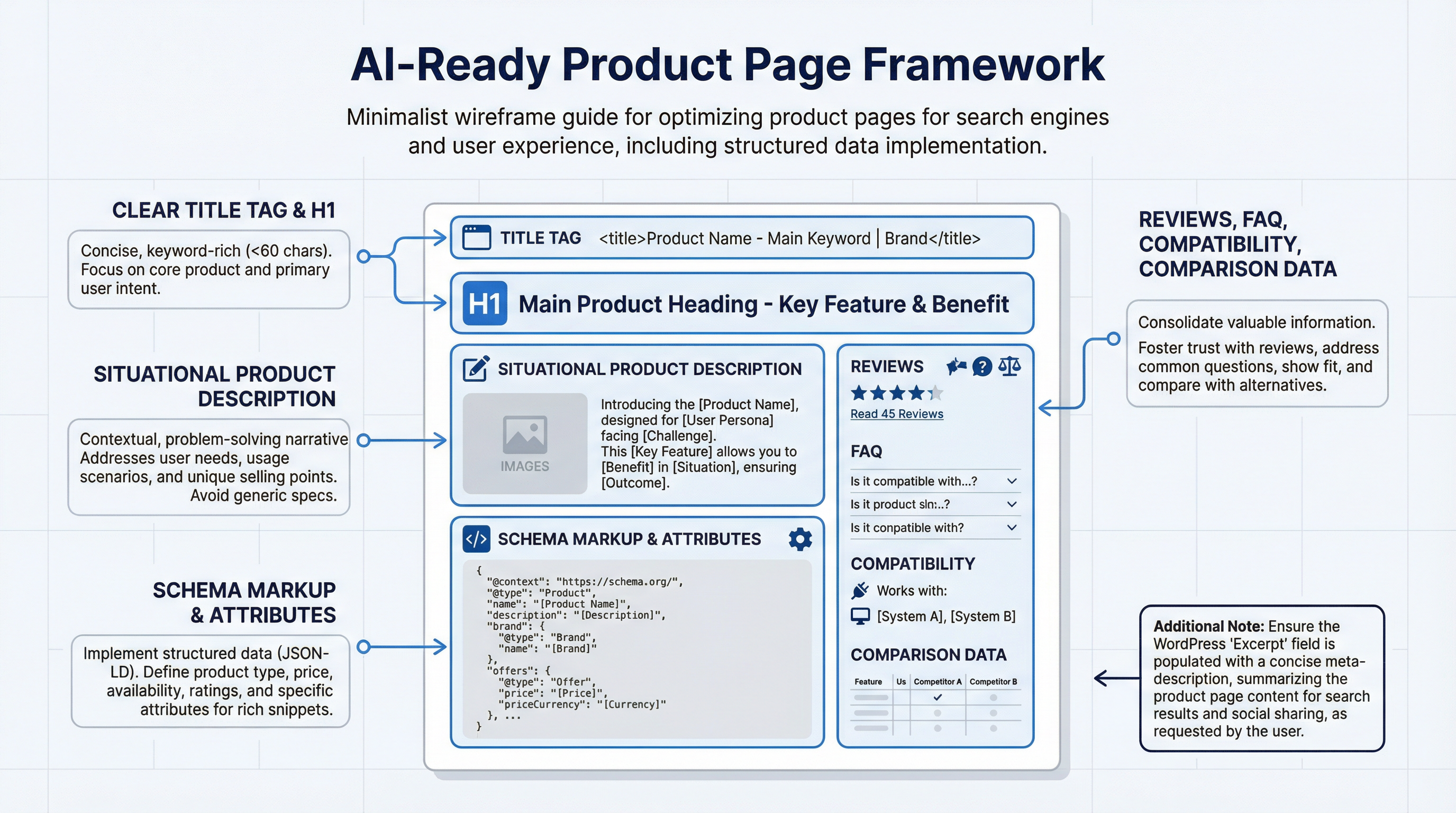
Title Tags & H1 Structure for AI Parsing
A product page title today works similarly to structured data.
When comparing products, AI systems will parse titles directly. Clarity in a title is exponentially greater in importance than using marketing terms.
The best way to write a product page title is:
Product Name — Major Feature/Characteristic | Brand<strong>Example:</strong>
StormLite Rain Jacket — Ultralight Waterproof Shell | NorthPeakUsing such structured data allows users to quickly and easily compare and find the major features of each product being compared. Most ambiguous titles (like “Amazing Jacket” or “Best Rainwear”) do not affect AI Recommendations since they lack measurable context.
Takeaway: Write titles for humans and machines at the same time.
Product Descriptions: From Keywords to Situational Content
Traditional forms of e-commerce SEO were often based around writing 300-word descriptions of a product that included numerous keywords. This type of content doesn’t provide nearly enough context for modern AI systems.
Optimizing product description pages today should focus on explaining situations, as opposed to solely describing specifications.
For example, instead of simply stating “Waterproof to 10,000mm”, you could state:
“Designed for unpredictable spring travel. Waterproof to 10,000mm and packs into a fist-sized pouch for day trips.”
This way, you are increasing Semantic Coverage Strength, which means the content is addressing every aspect of the semantic field associated with the product, including: material, weather conditions, durability, size, and compatibility.
Core product pages should contain at least 400 words of content that includes:
- Detailed specification lists
- Use case examples
- Compatibility data
- A brief FAQ section
- Comparison data
AI agents typically look to these sections when responding to consumer inquiries.
Keyword research still plays a role in developing product description content, but it must now support situational context versus repetitive keyword usage.
Takeaway: Product descriptions have to explain real-world scenarios.
Product Image Optimization
Visual search technology is rapidly expanding, particularly through Google Lens and AI mode.
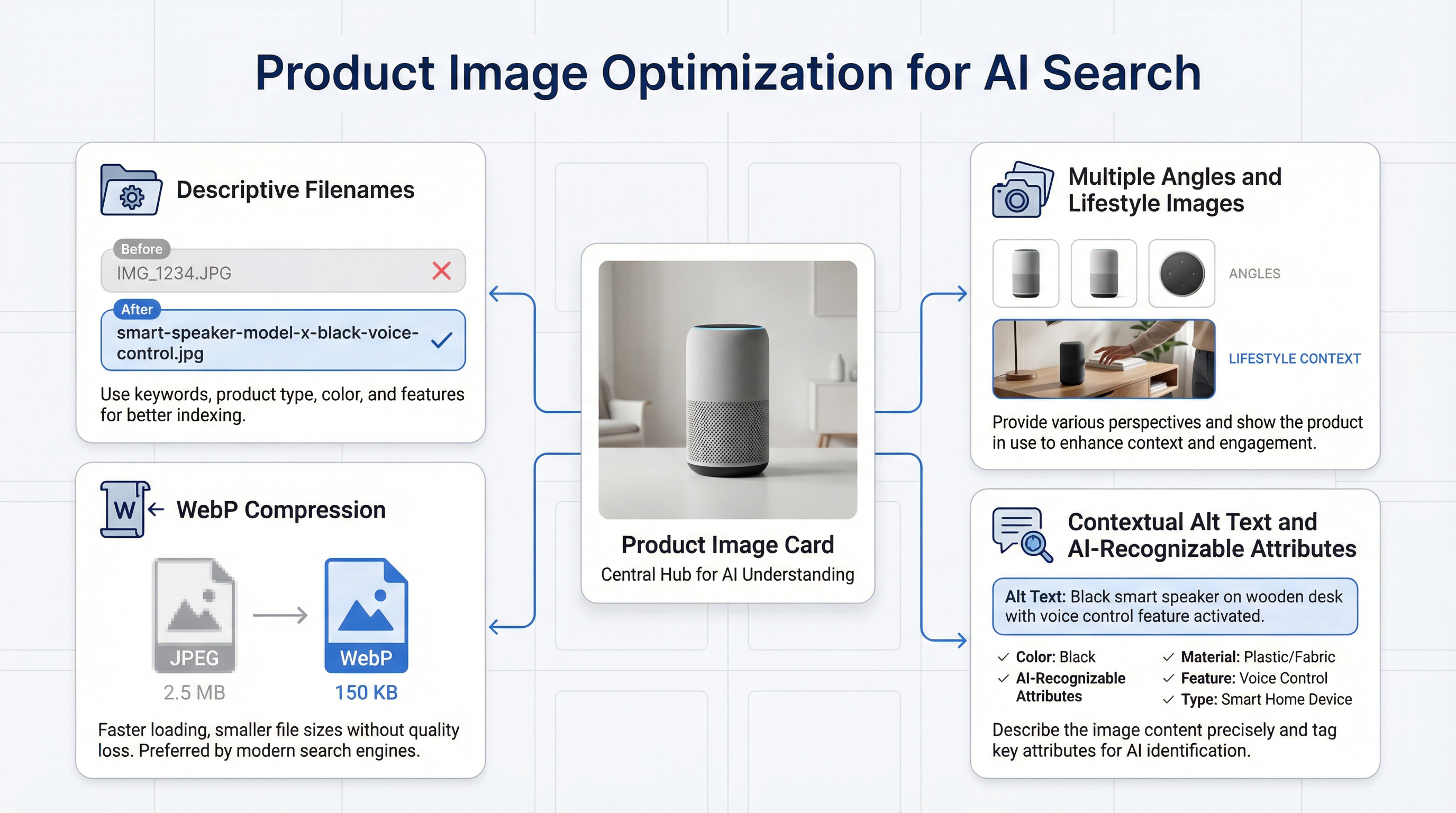
To optimize your product images, you will need to follow a very structured process:
- Descriptive file names
- Compressed WebP format
- Multiple angles and lifestyle shot images
- Contextual alt tags
A proper alt tag structure should resemble the following:
stormlite-rain-jacket-blue-travel-hiking.webpLifestyle images allow an AI system to have a clearer understanding of how a product would possibly be used by a consumer. This helps AI systems to display how products would be shown in actual usage within Search Engine and Visual Shopping Experience results.
Takeaway: Visual context helps AI systems recognize what a product is and where it can be used.
User Reviews as SEO Content
Customer reviews have evolved to become some of the strongest signals in the world of e-commerce SEO.
Each customer review adds its own distinct language to expand upon the semantic footprint of a product page. Customers naturally outline their own scenarios, problems, and outcomes when providing reviews — all of which are the exact types of context AI systems utilize to pair products with user queries.
Products with 50 or more reviews have approximately a 3.5 times higher likelihood of displaying in AI-based product recommendations.
Include review schema markup to allow Search Engines to directly read rating data.
Incentivizing customers to provide detailed feedback not only improves User Experience and Organic Traffic simultaneously, but also assists in providing context for AI-based product recommendations.
Takeaway: Reviews are one of the most scalable sources of SEO content.
UCP Readiness Checklist
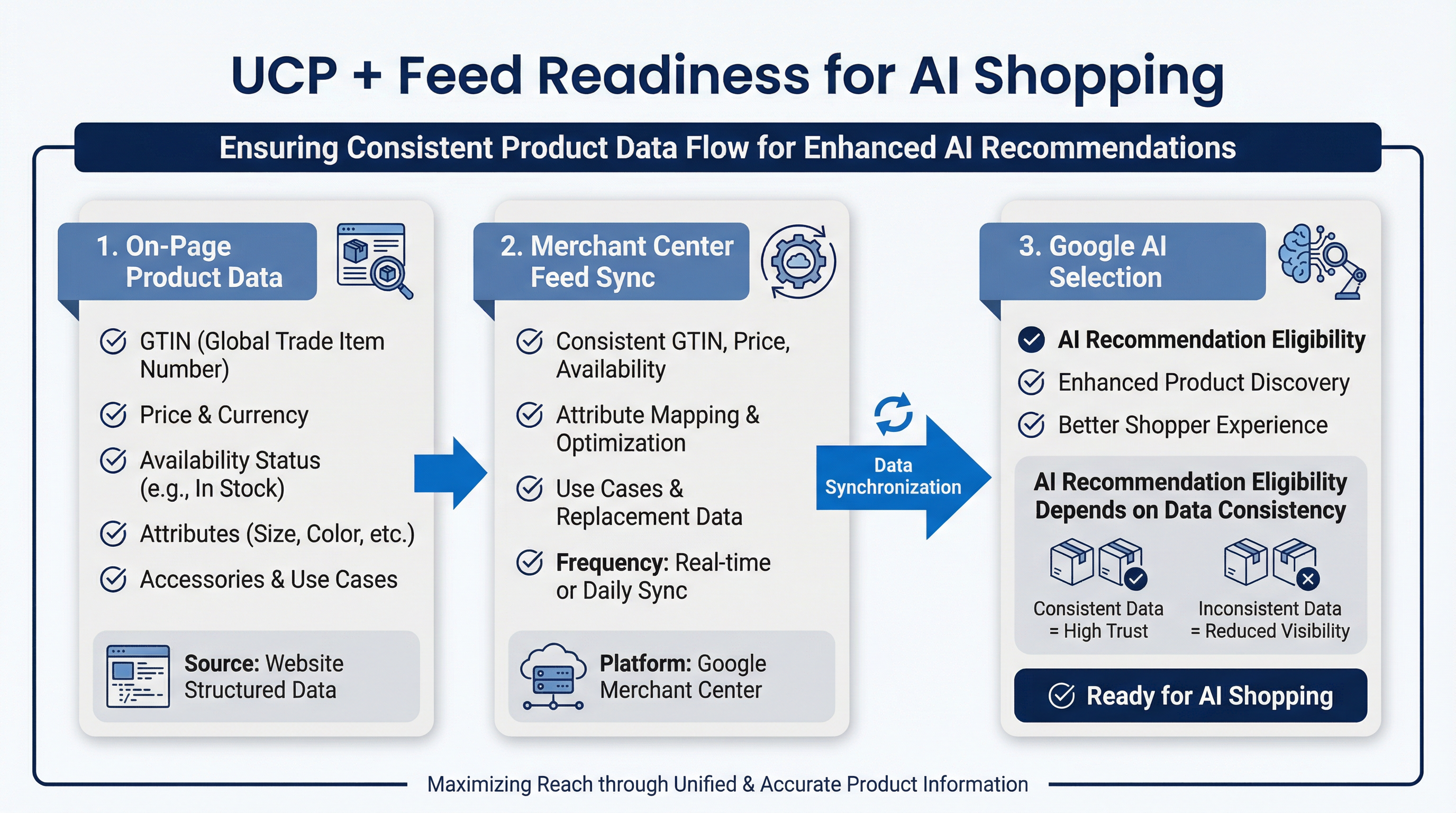
To fully engage in Google’s AI Commerce Ecosystem, product data must be properly formatted and structured.
Begin by implementing the following basic requirements:
- If your e-commerce platform offers it, implement the / .well-known / ucp endpoint
- Include GTIN, brand, and full attribute data in Merchant Center product feeds
- Include use case attributes, compatible accessory data, and replacement product data
These signals assist Google’s AI to match product data to conversational shopping requests.
Takeaway: AI recommendations depend on structured product data.
Category Page Optimization
Category pages are one of the strongest generators of organic traffic for an e-commerce site. Category pages are groups of products, and these groups of products are often ranked for valuable transactional keywords.
Additionally, category pages help search engines understand the focus of a store in the AI Commerce Era.
Category Titles & H1s
Using generic titles for category pages (i.e., “Products” or “Shop All”) does little to inform search engines about the content of the category page.
You should use the combination of category keywords and situational modifiers:
Women’s Rain Jackets — Travel-Ready & Packable
This combination will strengthen both the keyword targeting and contextual understanding of category pages.
Category Intro Content
The introductory section to every category page should include between 200 and 300 words of information about each aspect of the category (materials, seasons, user applications, etc.) prior to the product list/grid.
This section should describe all aspects of the category — materials, seasons, user applications, etc.
It is here that Semantic Relevance Grading becomes important, because search engines will determine if the content fully describes the category.
For example, the introductory content for a rain jacket category could describe waterproof ratings, packability, travel seasonality, and hiking conditions.
Faceted Navigation & Canonicals
Many large ecommerce sites have tens of thousands of filtered URLs — such as
/jackets?color=blue&size=mwithout proper canonical tags, creating duplicated content across many pages.
Use the safe rule: canonicalize filtered URLs back to the main category page except when the filter combination has meaningful search demand.
Internal Linking from Categories
Categories should internally link to:
- top performing product pages
- buying guide/blogs
- related categories
Linking in this manner will improve Cluster Authority Scoring and how search engines interpret the product taxonomy.
Takeaway: Category pages signal expertise across a product vertical.
Schema Markup for Ecommerce in 2026
| Schema type | Purpose |
|---|---|
| Product + Offer | Communicates price, currency, and availability. |
| AggregateRating | Communicates review data shown in search results. |
| FAQPage | Enables AI systems to extract direct answers. |
| BreadcrumbList | Clarifies site hierarchy. |
| ImageObject | Provides visual metadata for product identification. |
Schema Markup has transitioned from being a technical SEO improvement to being the primary means of communication between ecommerce sites and AI-driven search engines.
There are several schema types that are now necessary.
Product + Offer schema communicates the price, currency, and availability of a product.
AggregateRating communicates review data that appears in search results.
FAQPage schema enables AI systems to extract direct answers from product pages.
BreadcrumbList helps clarify the hierarchy of your website.
ImageObject provides visual metadata that can help identify products through images.
The March 2026 core update increased penalties for all ecommerce websites that incorrectly use structured data schemas. If the structured data schema claims characteristics of a product not found on the page, the search engine may downgrade the entire site.
Always validate schema by using the Google Rich Results Test and Schema Markup Validator.
An emerging best practice is to align merchant center feeds with the attributes on the page for schema markup. When choosing products for AI mode recommendations, Google cross-references both data sources.
Takeaway: Schema markup is the data infrastructure behind AI product discovery.
Google Merchant Center & Feed Optimization
Google Merchant Center is no longer an e-commerce retailer’s primary advertising platform, but rather a product database used by Google’s AI commerce platforms.
Feed Quality Essentials
A merchant feed with all products must contain:
- title • description • brand • GTIN or MPN • high-quality images of the product • accurate price and availability
The feed will also begin to have conversational attributes, including product use cases, compatible accessories, and most commonly asked customer questions.
Pay close attention to the pricing. Even a slight mismatch between feed data and the data on the website causes a product to be removed from AI shopping results.
Business Agent Activation
Retailers who meet specific requirements can activate the Business Agent in the Merchant Center.
Once activated in the merchant center, this AI tool will answer your customers’ questions in the search results and allow you to dictate the tone of the Business Agent, provide promotional messaging, and buying options. This interaction resembles a dialogue with a knowledgeable sales representative rather than simply browsing through a catalog.
Answer Equity Optimization
The strategic goal of Answer Equity Optimization is to create as many opportunities as possible for your brand to be included in the AI-generated recommendations.
Identify which competitors appear in AI mode recommendations so that you can identify potential gaps in your product feed or structured data.
Takeaway: Merchant Center is now part of the SEO stack.
Site Architecture & Internal Linking
Category Pages
Pillar content that defines product vertical expertise.
Blog Guides
Supporting informational content that expands topical coverage.
Product Pages
Transactional pages designed to convert intent into purchase.
Site design remains one of the most important aspects of e-commerce SEO.
The best e-commerce url structure will have a simple hierarchy:
domain.com/category/subcategory/productEach product page should be accessible through no more than 3 clicks off the home page. This allows for better crawling and usability for users and search engines alike.
Breadcrumbs provide context to both search engines and potential buyers that may visit your site.
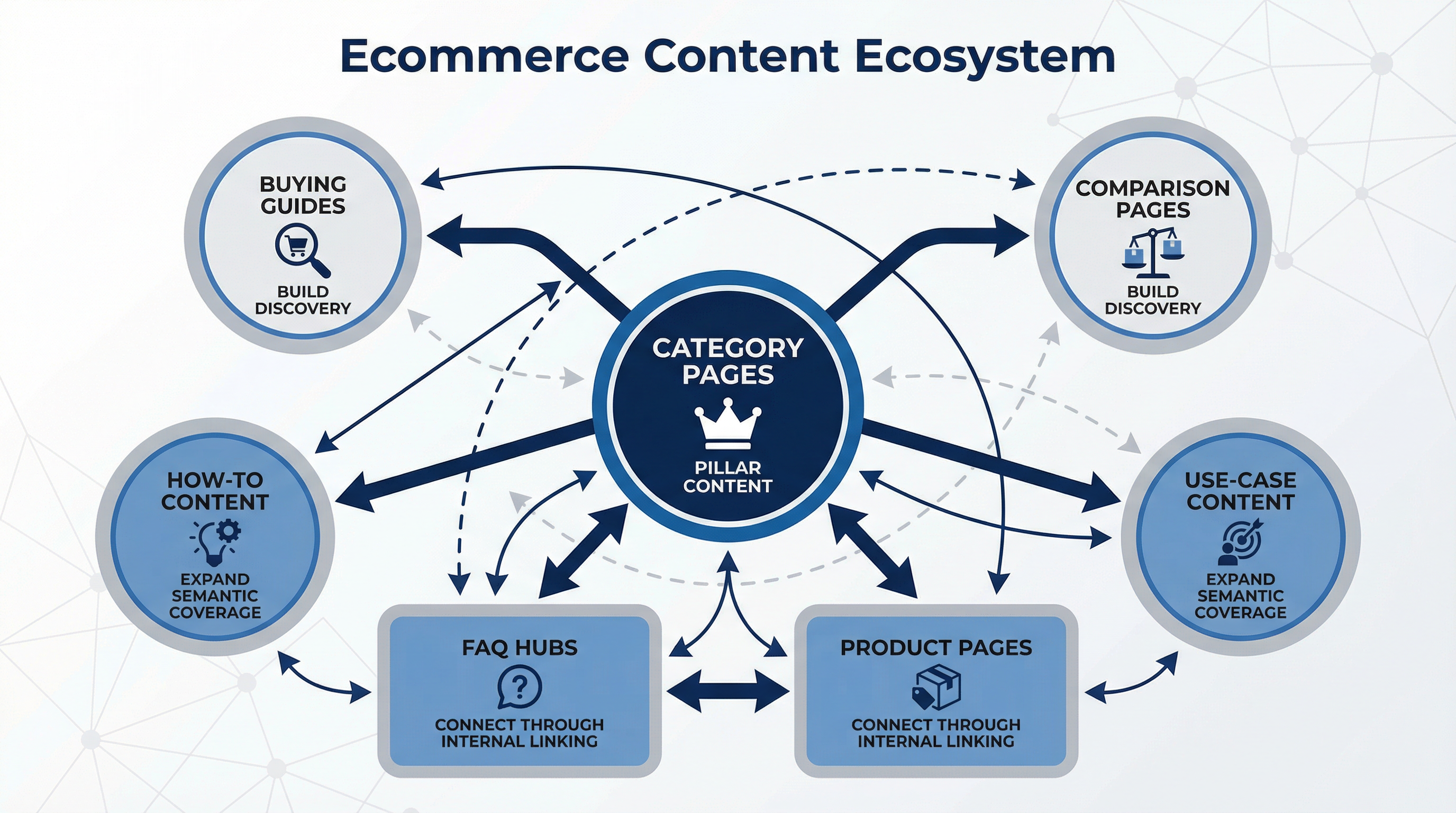
Your content should be organized into a “content hub” to improve your domain’s authority.
Category pages are the “pillar content.”
Blog guides serve as an information source (supporting) the category content.
Product pages represent transactional intent.
Using such a content strategy will aid in creating SERP Topic Consolidation by making it possible for your brand to appear on multiple search engine result pages (SERPs) at the same time.
Auditing regularly is necessary.
Pages that have zero internal links – referred to as “orphan pages” – are essentially invisible to both search engines and AI-powered systems. There are many tools available to help you identify such issues quickly, including Screaming Frog.
Takeaway: Site structure determines how authority flows across the ecommerce site.
Content Strategy for Ecommerce SEO in 2026
Content is the way to build demand, while product and category pages capture demand. That is still true today. What is different today, however, is how content feeds modern search engine and AI systems.
In 2026, much of the time informational content is the first touchpoint with a consumer before they reach a brand. Large percentages of queries have AI Overviews generated from them, and the answers provided to those queries are generally created from guides, comparisons, and how-to content rather than product pages. For many ecommerce brands, therefore, blog content is no longer simply a tool for marketing at the top of the funnel. Blog content is now infrastructure for AI discovery.
A typical ecommerce content strategy will involve the development of four main types of content.
Buying Guides
Buying guides continue to be some of the most solidified SEO assets available. Buying guides can rank in traditional search results, provide summaries to AI systems, and automatically link to relevant product and category pages for those who click through.
The difference between a good and a bad buying guide is the level of detail provided within the guide. In other words, a buying guide doesn’t just include a list of products; it provides explanations for materials, usage, tradeoffs, etc., for each product included in the guide.
Comparison Pages
Comparison pages are designed to capture users searching for high-intent product-related information. Users who are searching for “product A vs. product B” or “Shopify vs. WooCommerce” are generally near making a purchasing decision.
Comparison pages also provide structural information about the products being compared, and that information is commonly utilized by AI systems to provide comparison-based answers to users’ prompts.
Use-case and How-to content
Use case and how-to content increase the semantic footprint of an ecommerce website. Content such as “How to Pack a Rain Jacket for Travel,” or “Layering Clothing for Winter Hiking” naturally references products without sounding promotional.
AI assistants will frequently pull information from these types of articles when trying to explain how products solve real-world problems.
FAQ Hubs
FAQ hubs are another source of untapped potential. Many ecommerce teams will answer their customers’ questions via their support channel but will never take that same information and turn it into searchable content (i.e., FAQs).
Creating FAQ hubs and including that information in the FAQ’s not only increases the semantic coverage of an ecommerce site, but also captures People Also Ask queries and conversational searches.
When these four types of content are linked to product and category pages through internal linking, it develops a content ecosystem that can support all of an ecommerce sites SEO strategy.
Takeaway: Content hubs help ecommerce brands appear throughout the customer journey.
Measuring On-Page Performance in 2026
| Measurement layer | What to track | Typical issues |
|---|---|---|
| Traditional Search Visibility | Impressions, clicks, CTR, page-type performance | Weak titles, meta descriptions, low conversion on product pages |
| AI-driven Product Discovery | AI Mode appearance rate, recommendation visibility | Weak feed, poor schema, insufficient semantic content |
| Technical Data Quality | Feed diagnostics, schema validation, attribute integrity | Missing attributes, pricing mismatches, image errors, broken schema |
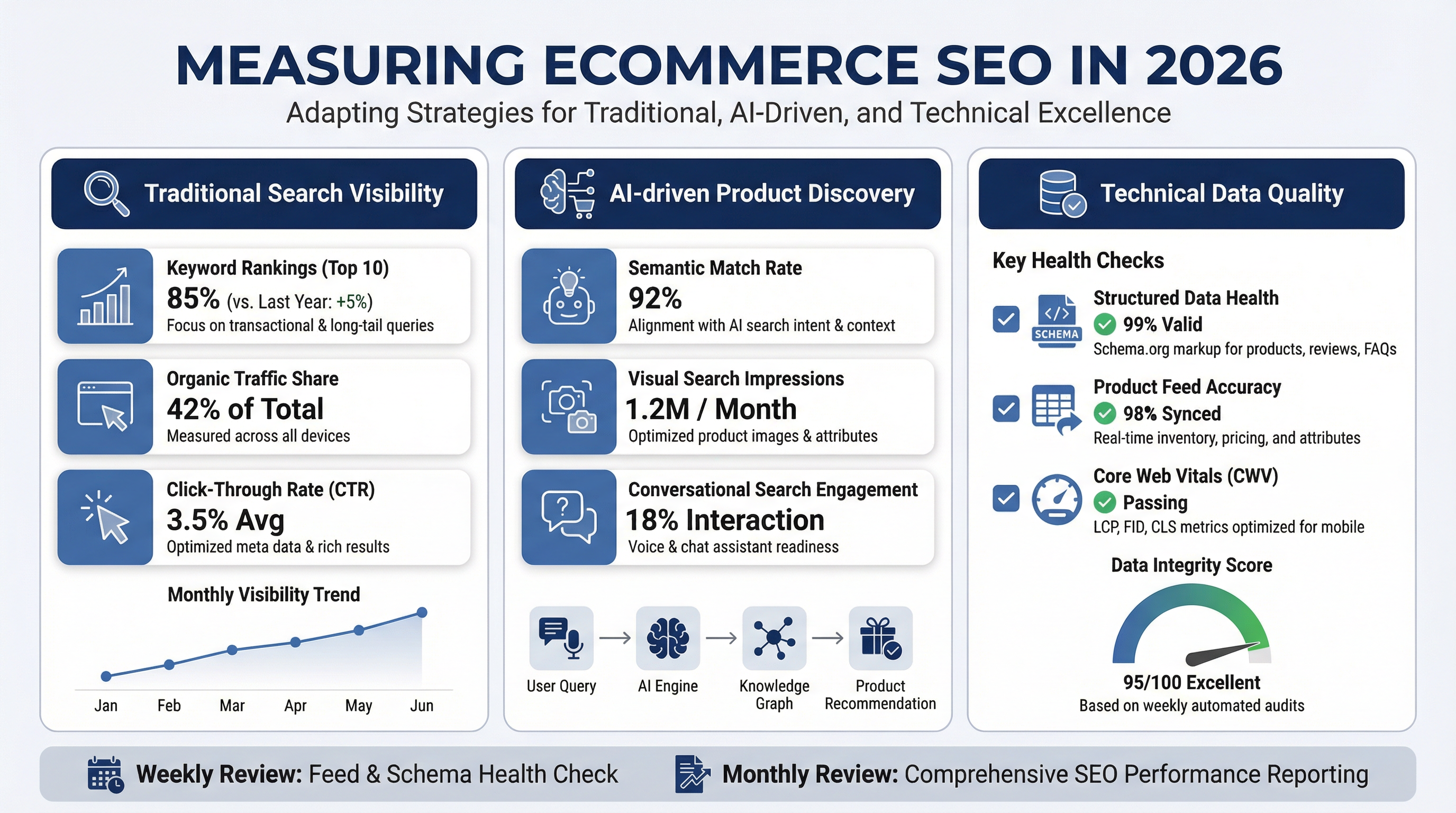
Evaluating ecommerce on-page optimization has also changed. To measure ecommerce SEO performance, you need to evaluate performance across three levels.
Traditional Search Visibility
The first level of performance measurement is still evaluating performance in traditional search. Tools like Google Search Console are still very valuable for looking at impressions, clicks, and CTR across product and category pages.
Measuring performance by page type can also be highly beneficial. For example, if your category pages have high impression levels but low click-through rates, there may be an issue with your title tags or meta descriptions.
Similarly, if your product pages have high traffic but low conversion rates, it is likely that there are usability or product information issues that need to be addressed.
AI-driven Product Discovery
The second level of performance measurement is evaluating AI visibility.
As there are still developing tools to measure AI visibility, platforms such as Merchant Center and specialty SEO tools are starting to give insight into how often products appear in AI-generated shopping recommendations. This metric is referred to as the “AI Mode appearance rate.”
If competitors are consistently showing up in conversational search results and your products aren’t, the issue is typically due to a poorly developed product feed, poor schema markup, or a lack of enough semantic content on product pages.
Technical Data Quality
The third level of performance measurement focuses on data infrastructure. Merchant Center diagnostics are helpful in identifying issues with product feeds, such as missing attributes, incorrect pricing, or image errors.
Structured data should be validated regularly with the Google Rich Results Test. Errors with broken schema or mismatched attributes keep products from appearing in enhanced search results.
Another useful perspective is evaluating the topic cluster coverage of your site.
Using tools such as Ahrefs or Semrush, you can determine how well your ecommerce site covers an entire product category and whether your brand is moving towards Search Topic Domination across buying guides, comparison pages, and product listings.
If your competitors appear across all of these formats, while your site only appears with product pages, this would indicate a clear deficiency in your SEO strategy.
You should review product feed issues and schema errors every week, as they directly affect the ability of the products to be visible.
You should review the bigger picture of ecommerce SEO performance, including organic traffic, keyword rankings, and topic coverage, at least monthly.
Takeaway: e-commerce SEO measurement now includes both rankings and AI-based visibility.
Conclusion
By 2026, on-page SEO for ecommerce means optimizing for two search systems: traditional search engine rankings and AI-based product selection.
Brands that win this transition will be those that optimize their product data, improve the quality and quantity of their semantic content, and prepare their ecommerce sites for AI-based discovery.
At Crowdo, we help ecommerce teams build the authority and visibility needed to compete in this evolving search environment.
Related Posts
Written by