
Enterprise SEO is not just “large-site SEO.” It is the operating model larger organizations need when they are managing thousands to millions of URLs across multiple domains or subdomains, several markets and languages, and release processes involving more than one team. At that scale, the real work moves from page-by-page edits to systems, governance, and coordinated execution across the organization.
You should think about enterprise SEO when organic performance depends on repeatable systems rather than one-off wins. Crawl efficiency, technical consistency, template logic, localization, internal linking, reporting, and stakeholder coordination all matter at the same time. In 2026, the scope is broader still, because enterprise teams also need to understand how their content shows up in AI-driven search environments.
Picture a site with thousands of pages where one internal-linking rule change, canonical update, or faceted-navigation fix must pass through marketing, product, engineering, analytics, and legal before it reaches production. That is the real start of enterprise SEO. The difficulty is not page count alone. It is scale plus coordination plus risk.
Direct answer: Enterprise SEO, sometimes called corporate SEO, is search engine optimization designed for large organizations with thousands or even millions of pages, multiple brands or regional sites, and multiple departments involved in implementation. Unlike traditional SEO, enterprise SEO relies on systems, automation, and cross-functional execution to move business outcomes.
What Is Enterprise SEO?
Enterprise SEO is the process of developing, managing, and optimizing organic search visibility for complex websites whose scale changes the way the work must be done. The core principles stay familiar — crawlability, indexation, link equity, content quality, and authority still matter — but once you add templates, multiple markets, CMS limitations, and many stakeholders, the objective shifts from optimizing individual pages to building systems that can be executed consistently.
In practice, “enterprise” describes a set of working conditions as much as company size. If your site spans multiple regions or languages, contains hundreds of thousands of URLs, depends on several teams to approve changes, or has meaningful implementation risk, you are already operating in an enterprise SEO environment.
When Is Enterprise SEO the Right Move?
Enterprise SEO becomes necessary when organic growth depends on repetitive systems rather than isolated fixes. That usually means some mix of high URL volume, repeated technical debt, multiple site sections with different owners, localized or near-duplicate content, and reporting requirements that go beyond traffic into revenue, pipeline, or regional performance.
If your site has a manageable number of pages, one market, a simple stack, and only a few decision-makers, you probably do not need a full enterprise SEO program. In those cases, a traditional SEO retainer or a technical/content engagement is often enough. Enterprise SEO is worth the cost when coordination risk and implementation risk are greater than the upside of ad hoc campaign work.
A simple test: if a single search change can affect hundreds or thousands of pages, and shipping that change requires multiple teams to agree, you are likely already working in an enterprise environment.
Enterprise SEO vs. Traditional SEO
| Dimension | Traditional SEO | Enterprise SEO |
|---|---|---|
| Scale | Dozens to hundreds of important pages | Thousands to millions of URLs, often across templates or domains |
| Technical complexity | One site, one CMS, fewer dependencies | Multiple CMSs, subdomains, migrations, feeds, faceted navigation, legacy rules |
| Team and stakeholders | Often one owner or a small marketing team | SEO, engineering, product, content, analytics, legal, regional teams |
| Content model | Individual pages and campaigns | Templates, workflows, governance, localized and programmatic production |
| Link building | Campaign-based outreach | Ongoing authority development across priority categories and markets |
| Data and reporting | Rankings and traffic are often enough | Revenue, forecasts, business cases, segment-level reporting, executive dashboards |
| Risk and governance | Lower blast radius | Higher blast radius, compliance risk, release risk, brand risk |
The big idea is that enterprise SEO is not just “SEO on steroids.” It is SEO that must operate through systems, workflows, automation, engineering support, and governance structures. Large organizations do not succeed because one person manages a checklist well. They succeed when teams can repeatedly ship the right changes across a complex environment.
What Makes Enterprise SEO Different
Scale — Thousands to Millions of Pages
At enterprise scale, crawl budget and indexation are no longer theoretical ideas. Duplicate URLs, faceting, weak canonical logic, and low-value pages can waste crawling resources that should be reserved for high-value pages. The larger the site becomes, the more expensive sloppy technical rules become.
Complex Technical Infrastructure
Enterprise websites often run across multiple CMSs, subdomains, feeds, rulesets, and legacy systems. Migrations, rendering issues, indexation logic, redirects, faceted navigation, and templated metadata are not side concerns — they are the daily operating reality. That complexity is exactly why enterprise SEO cannot be reduced to content calendars alone.
Cross-Team Coordination and Stakeholders
The largest enterprise SEO challenge is often organizational rather than purely technical. Product roadmaps, engineering backlogs, legal reviews, analytics requirements, and regional business priorities can all compete against SEO recommendations. Even strong recommendations fail when ownership, approval, and timelines are unclear.
Scalable Content and Automation
Large websites cannot manually optimize every page. They need scalable content models, sensible templates, reusable components, editorial guardrails, and carefully governed automation. Programmatic SEO can be powerful when built on useful data and human QA; it can also create large-scale thin or repetitive content when governance is weak.
Risk and Governance
Enterprise sites have a much larger blast radius. One robots directive issue, canonical rule flaw, or template mistake can impact thousands of URLs instantly. The same goes for business operations: weak reporting can cause leadership to deprioritize working initiatives, while poor vendor governance can create long-term link or compliance risk. At this level, prevention is much cheaper than recovery.
The Core Components of an Enterprise SEO Program
Technical SEO at Scale
Technical SEO at the enterprise level means keeping sites easy to crawl and index, fast enough for users, and stable as the platform evolves. That work includes template QA, indexability control, XML sitemaps, canonical logic, rendering checks, redirect governance, and periodic audits across large URL sets. If you need a foundational companion piece, Crowdo’s guide to technical SEO is a useful reference.
Site Architecture & Internal Linking
On a very large site, architecture is more than navigation design. It defines how authority moves across templates, hubs, facets, and supporting pages. Internal linking becomes its own workstream because taxonomy changes and template rules can create discovery issues or keyword overlap at scale. Related reading: SEO internal linking and keyword cannibalization.
Scalable Content Production
Large content operations need more than writers and briefs. They require template governance, editorial guidelines, approval paths, localization rules, and measurement systems for hundreds or thousands of assets. Automation is allowed, but only when output remains accurate, relevant, and accountable.
Link Building & Digital PR at Scale
Enterprise link building usually looks more like a portfolio than a single campaign: category pages, owned research, expert commentary, digital PR, partner ecosystems, and risk controls. Because this work depends on process, QA, and relationships, many organizations outsource part of it. If your team is deciding what to keep in-house, it helps to understand SEO outsourcing and how a white label SEO partner can support execution.
International & Multi-Domain SEO
International SEO adds another layer of complexity because URLs, templates, and governance multiply across markets. Language versions, hreflang, localization signals, and duplicate-control decisions all need to stay aligned. Crowdo’s guide to international SEO best practices is a helpful companion here.
Reporting & Analytics Tied to ROI
Enterprise reporting has to connect search work to business impact. Rankings still matter, but leadership wants to know which templates, categories, markets, or fixes affect leads, revenue, margin, and pipeline. That means page-group reporting, implementation status tracking, regional and product-line segmentation, and a methodology for separating leading indicators from business outcomes.
Enterprise SEO Platforms vs. Standard SEO Tools
Standard SEO tools are valuable for research, audits, rank tracking, and competitor analysis. On their own, however, they usually do not solve enterprise workflows involving multiple domains, multiple users, integration requirements, permission levels, automation, project management, and executive reporting.
Enterprise platforms are built to coordinate both data and action across large organizations. The real decision is not just which tool has more features. It is whether your organization needs centralized governance, API connectivity, automated tasks, multi-domain reporting, and broader workflow management than standard tools can support.
Enterprise SEO in 2026: Winning at AI Search
AI-driven search has changed enterprise SEO because buyers no longer discover brands only through classic blue-link journeys. The fundamentals still matter: pages need to be indexable, useful, clearly written, internally connected, and strong enough to qualify for search visibility. But enterprise teams also need to think about how those same assets perform in AI-shaped answer environments.
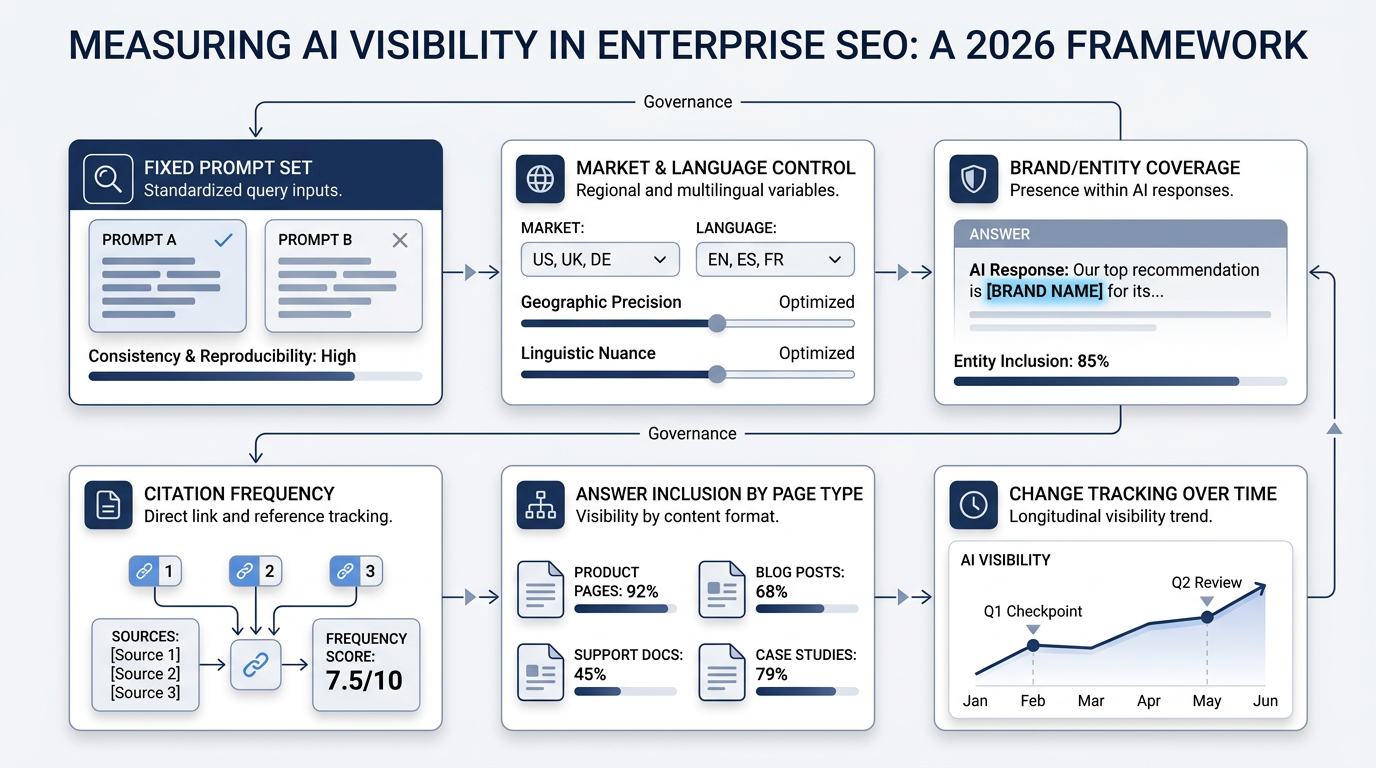
The stronger hypothesis layer now includes passage-level answers, entity reinforcement, consistent terminology, comparison blocks, FAQs, and accurate schema. These do not deterministically “trigger” citations, but they often improve how systems read, understand, and reuse your content. For practical background, see LLM citation-friendly SEO, why your website still matters in AI search, the GEO glossary, and the distinction between SEO vs. GEO.
Practically speaking, enterprise GEO/AEO work usually involves five activities: structuring key pages around definitions and decisions, reinforcing entities across templates, keeping schema aligned with visible text, strengthening internal links from supporting pages to revenue pages, and measuring visibility with a stable methodology instead of anecdotes. If this has become material to your pipeline, focused GEO support starts to make sense.
How Much Does Enterprise SEO Cost?
There is no honest universal market rate for enterprise SEO. Costs swing widely based on scope, implementation burden, domain complexity, geographic spread, content volume, and reporting requirements. A better way to discuss cost is to look at published examples with clear attribution, then explain which factors actually drive the number.
Published examples, not market rates
| Model | Published range | Publisher | Date | Scope |
|---|---|---|---|---|
| Agency retainer | $7K–$21K+/month; 80–240+ hours at about $90.7/hour | SeoProfy | Published 2025-12-30, updated 2026-05-29 | Large national to complex multi-market campaigns |
| Agency / global | From about $10K/month to $50K+ | TripleDart, citing Directive Consulting | 2026 | Global or multi-language enterprise campaigns |
| Agency peer framing | $8K–$10K/month, with many engagements above $21K/month | ResultFirst | 2026 | One agency’s framing for enterprise SEO services |
| Platform subscription | $30K–$200K+/year; $100–$300+ per user per month | Conductor Academy | 2026 | Annual enterprise platform contracts and seat pricing |
| Traditional SEO contrast | About $2,917/month | Digital Elevator | 2026 | One published estimate for general SEO, used only as contrast |
These figures should not be treated as universal benchmarks. They are published examples that help frame the discussion. The real cost driver is not just “SEO hours.” It is the number of internal teams involved, the implementation burden, the number of page types and markets, the reporting complexity, and whether the program includes migrations, link acquisition, or AI-search measurement.
How to Choose an Enterprise SEO Partner or Platform
Use this checklist before signing anything:
- Scalability: Can the team or platform handle your real page volume, templates, markets, and release cadence?
- Integrations and APIs: Can it connect with your CMS, analytics stack, BI tools, and engineering workflow?
- Technical depth: Can it diagnose rendering, indexation, migration, and architecture issues — not just output audits?
- ROI reporting: Can it map work to business outcomes, not only rankings?
- AI-search capability: Can it explain how AI visibility is measured without overpromising deterministic results?
- Security and compliance: Can it work within procurement, legal, and data requirements typical of large organizations?
- CMS experience: Has it worked with a stack like yours before?
- Execution model: Which pieces does it actually do, and which are left to your internal team?
A useful filtering question is whether you need an enterprise SEO agency, an enterprise SEO consultant, a platform, or a hybrid. Platforms centralize data and workflow. Agencies and consultants turn priorities into shipped work. Many large organizations use both because the bottleneck is not insight alone — it is implementation. For a buyer-side perspective, see Crowdo’s guide on searching for the right SEO agency.
If you are scaling SEO across a large site and need help with the pieces most teams outsource — technical fixes, link building, or AI-search visibility — we are happy to talk through what that looks like.
Common Challenges & Why Enterprise SEO Fails
Enterprise SEO usually fails for very ordinary reasons. The recommendations may be solid, but ownership is unclear, product roadmaps take priority, local teams ignore template logic, reporting does not prove value, or the organization moves too slowly to support implementation. In many cases, the people and process issues are larger than the SEO issues.
The technical failure modes are familiar: crawl waste, duplicate URLs, weak canonicals, localization errors, poor internal linking, and template changes that strip out important content or markup. Vendor-related failure modes also matter, including low-trust link building, vague reporting, and black-box promises. If you need a refresher on why shortcuts age badly, revisit Crowdo’s overview of black hat vs. white hat SEO.
How Long Does Enterprise SEO Take to Show Results?
Enterprise SEO should be evaluated on a quarterly rhythm, not a weekly one. Even after fixes are approved and deployed, re-crawling and re-processing can take days to weeks, and business impact usually trails technical improvement. This is especially true when multiple teams, release schedules, and regional rollouts are involved.
A realistic expectation is that you may see early operational wins within one quarter of shipping meaningful fixes, but stronger organic and business outcomes often require two or more quarters of sustained implementation. Enterprise SEO is rarely about one big reveal. It is usually about repeated improvements compounding over time.
Frequently Asked Questions
What is enterprise SEO in one sentence?
Enterprise SEO is search engine optimization built for large organizations whose scale, complexity, and implementation risk require systems, governance, and cross-functional execution rather than page-by-page tactics.
What’s the difference between enterprise SEO and traditional SEO?
Traditional SEO usually operates on one site with fewer stakeholders and lower risk. Enterprise SEO operates across many URLs, templates, regions, and teams, so workflow, governance, reporting, and systems become central to success.
How do I know if I need enterprise SEO?
You likely need it if your site spans many URLs or markets, technical fixes regularly sit in backlogs, multiple teams must approve changes, or a single rule change can affect hundreds or thousands of pages at once.
How much does enterprise SEO cost?
Published examples in 2026 range from roughly $7K–$21K+ per month for some agency retainers to $10K–$50K+ for global campaigns, while enterprise platforms can reach $30K–$200K+ annually. Scope, implementation burden, and reporting complexity drive the price more than hours alone.
How long does enterprise SEO take to show results?
Usually at least a quarter for the first meaningful operational impact, and often two or more quarters for stronger organic and business outcomes. The bigger the organization, the longer coordination and release cycles tend to be.
How is enterprise SEO changing with AI search?
Enterprise SEO now includes clearer answer-oriented passages, stronger entity coverage, valid structured data, better internal linking for supporting content, and repeatable measurement of AI-search visibility across a fixed set of prompts and markets.
Do I need an enterprise SEO platform, an agency, or both?
That depends on your bottleneck. A platform centralizes data and workflow. An agency or consultant helps turn priorities into shipped work. Many enterprise teams need both because insight alone does not remove implementation friction.
The Bottom Line
Enterprise SEO makes sense when your website has become a systems problem: too many URLs, too many owner groups, too much release risk, and too much business value tied to organic performance for ad hoc SEO to keep working.
The organizations that win are not always the ones with the biggest sites or the biggest tools. They are the ones that translate SEO into governance, engineering, reporting, and repeatable operating systems that survive real-world complexity.
Crowdo supports components of enterprise SEO programs — link building, technical SEO, and GEO/AI-search support — and can also work as a white-label execution partner for agencies. If that is the type of support you need, start with fully managed SEO or GEO services.
Related Posts

Written by